
Australian immigration law: changes and prospects in 2019
In this article, I will highlight the new visa changes in relation to the new sponsorship framework for family visas and the impact of longer processing times and delay on family sponsored visa category. The article will conclude that these changes are part of a broader ‘neoliberal’ agenda of the Australian government that focuses more on securitisation and border control rather than on the well-being of migrants and their families here and abroad.
New sponsorship framework
The Migration Amendment (Family Violence and Other Measures) Act 2018 has now been passed in the Australian parliament to provide extra requirements for people seeking to sponsor family members under family sponsored visas.
The main feature of this new framework is that it creates a two-stage application procedure, which requires first the assessment of the sponsorship, and once the sponsorship is approved, then the visa application can be lodged.
This is a very tough rule which means that the lodgement of the visa application may be delayed until a family sponsorship application is approved. For instance, if your student visa or tourist visa is expiring in a month or two, you cannot lodge an onshore partner visa application because you must wait for the approval of the sponsorship, which could take a few months to process given that, nowadays, it is taking a long time to process a partner visa application (see the second major changes below).
This new framework also shows a significant departure from any past and present sponsorship regime, such as those for the Temporary Skill Shortage (TSS) visa and Employer Nomination Scheme (ENS) visa, where sponsorship application and visa application can be lodged at the same time.
One of the primary objectives of the new sponsorship framework is to extend the government’s power to scrutinise sponsors with a violent criminal history, particularly those who have a history of family violence.
This new framework would also extend to a new temporary sponsored parent visa that will allow parents of migrants to stay in Australia for a period of up to five years.
Under this new parent visa, the applicant can ask for a three-year visa for a fee of $5,000 or a five-year visa for $10,000—a very expensive lodgement fee which many migrants may not be able to afford.
Sponsors of this parent visa would have to ensure that their parents have health insurance and do not incur any healthcare costs to Australian taxpayers. This would certainly put a heavy burden and discouragement to sponsors as ‘legally-bound’ financial guarantors.
Longer processing times and delay
The above change on sponsorship requirement has a profound impact on processing times and waiting period for applicants who applied under family sponsored visas.
As a result of this two-stage process of sponsorship and visa application, it means that there would be more waiting time for partner visa application because both applicants and sponsors will have to go through a rigorous process of internal checking regarding their identity, character, travel history, employment and so on.
Yet, even before these new changes were introduced, partner visas were already taking nearly 18 months to process for offshore applications and up to 25 months (nearly two years) for onshore applications.
One of the main reasons for this long processing period has been the result of the government’s cut in the migration intake. According to the government’s report, Australia’s annual permanent migration intake in 2017-2018 has been reduced to 162,417, which is well below the 190,000 places planned in the budget.
The previous Minister for Immigration Peter Dutton argues that this cut to the migration intake is indeed necessary to weed-out “applications lodged by individuals with complex immigration histories, including extensive travel histories, unsuccessful visa applications and/or periods of being unlawful in Australia”.
This entails increased scrutiny that includes more character and bona fides checks, which would further result into more delays and longer processing times.
The other major reason is related to the present culture of ‘securitisation’ and ‘border control’ which impacts on the way resources and budget are allocated within the Department of Immigration, which has now become part of the ‘super-ministry’ Department of Home Affairs that combines various government agencies including immigration and citizenship, customs and border control, national security and counter-terrorism and multicultural affairs.
It is apparent that outsourcing of public service and prioritisation of resources to border security and terrorism (rather than the visa processing) is the main goal of the current Australian government. It is revealed that “more than 250 public servants at the Department of Immigration and Border Protection face sack as the department moves to outsource its key call centres to a private operator”.
Home Affairs Secretary Michael Pezzulo told the Senate committee that the Department’s stance on border protection is of paramount importance, saying that even if more staff and funding becomes available it will most likely not be used to improve visa processing times.
It is worrying to see that administrative measures such as these are being used to slow the processing of visa applications for political reasons.
Conclusion
To conclude, it appears that these changes are nothing new but the continuation of the government’s cling to neoliberal strategy of ‘economic rationalisation’ on Australia’s migration program.
We are witnessing a complete overhaul of the migration policy that select migrants who are young, skilled, mobile, with excellent English language, and are able to quickly contribute to the Australian economy.
In the government’s point of view, migrants who do not fit within this ‘ideal’ model is therefore undeserving and unworthy to become a member of Australian society. Indeed, Australian permanent residency and Australian citizenship come with a high price.
Despite all these changes, migration to Australia will continue. But what we need is a new perspective that puts human being (the migrant) at the centre of the discussion, rather than the state’s focus on profit-making, criminalisation of migrant community and border control.
References:
Button, James, ‘Dutton’s Dark Victory’, The Monthly (February 2018)
Department of Home Affairs, Annual Report 2017-2018 (May 2017)
Mares, Peter, ‘Migration by numbers’, Inside Story (5 November 2018)
Towell, Noel, ‘Hundreds of public servants face sack as Immigration outsources visa centres’, The Sydney Morning Herald (16 May 2017)
*This article first appeared in Batingaw (Issue 40, Jan-Feb 2019), Migrante Australia’s Newsletter, in a slightly different version.
Irresponsible Australian mining in the Philippines persists

In 2008, I met Manoy Tony, an elder from the island of Rapu-Rapu in Bicol region, and Frances Quimpo, from the Centre for Environmental Concerns in the Philippines (CEC), in a public forum held in Melbourne about large-scale mining activities in the Philippines.
In the forum, they pointed out how huge mining companies like the Lafayette Philippines Inc, a subsidiary of an Australian mining company, have substantially destroyed the environment and community’s livelihood as a result of cyanide spills, pollution and depletion of water resources.
In fact, Lafayette’s two mine spills in Rapu-Rapu that happened in 2005 was amongst “the worst mining disasters in the Philippines”. Recent report shows that rehabilitation work on the mine site and surrounding coastal communities in Albay and Sorsogon has been very slow and the cost of rehabilitation has now ballooned to P310 million (‘Slow progress in Rapu-Rapu mine rehabilitation’, Rappler, 08 May 2018).
OceanaGold in the spotlight
Today, the issue of negative impact of large-scale mining in the Philippines continues. Another Australian-Canadian mining giant, OceanaGold, is the subject of a major research study done by the Institute of Policy Studies and Mining Watch Canada in relation to the company’s dangerous and irresponsible mining activities in Didipio, Nueva Vizcaya.
The report is based on a number of years of study and site visits on numerous fact-finding missions in the country since 2013. It found that OceanGold has violated several national and provincial laws and decrees and concluded that the mine “has significant negative impacts on water, forests, land, indigenous peoples, human rights, biodiversity, and workers’ rights” (Robin Broad et al, OceanaGold in the Philippines: Ten Violations that Should Prompt Its Removal, 31 October 2018).
As a result, the study recommends that the Philippine government should refuse OceanaGold’s renewal of its licence after June 2019 as well as requests by the company for new exploration permits.
The OceanaGold’s Didipio Gold and Copper Mine Project in the Northern Luzon province of Nueva Vizcaya is indeed one of the manifestations of the country’s utterly flawed, anti-people policy on mining. It shows the ‘dark side’ of mining liberalisation on the Philippine economy, particularly the violation of the country’s sovereignty and national patrimony.
Many people are led to believe that foreign investment is good for the country because it generates income, economic development and local employment for the poor people in the communities.
But this view is deeply flawed and short-sighted. How can a responsible mining industry contribute to the national development of a country whereby people’s lives and natural habitat of the local community are being disregarded?
The Philippines ranks amongst the world’s mineral-rich countries when it comes to gold, copper, nickel and chromite. But the country’s mineral resources only benefit large foreign companies and not the Filipinos who can use these resources to develop its national industrialisation (IBON, ‘PH minerals benefit foreigners not Filipinos’, 14 Mar 2017).
Since the passage of the Mining Act of 1995, the Philippine government has been actively pursuing the implementation of a neoliberal program for the mining industry, under which twenty-five percent of the country’s land area becomes potentially devoted to mining (section 5 of the Act).
Huge incentives are given to mining firms by way of tax-free operations for the first five years and the relaxation of mining permit applications and the implementation of environmental regulations, assessment and its impact.
Human rights violations and Australian involvement
The more disturbing issue, however, is the ever-increasing human rights violations and extrajudicial killings of human rights activists who advocate for ordinary people and local communities opposed to large-scale mining operations.
Several studies reveal that human rights violations against anti-mining activists and environmental advocates are in fact perpetrated by the Philippine military and its security forces (Aytin 2016; Holden, Nadeu and Jacobson, 2011).
It is no coincidence that mining-related political killings have intensified since the creation of Investment Defense Force (IDF) to silence any opposition to mining.
Here, it is worth noting Australia’s continuous military and intelligence support to the Philippine military in the wake of the Marawi crisis. In the Australian Department of Foreign Affairs and Trade (DFAT) website, it states that the Australian Defence Force (ADF) provided surveillance support and counter-terrorism specific training to the Armed Forces of the Philippines.
Specifically, it reveals that “approximately 100 AFP, PCG, and DND personnel undertake education and training in Australia each year, while several hundred participate in training provided through MTT [ADF Mobile Training Team] visits to the Philippines” (DFAT, ‘Philippines country brief’).
Given the continuing escalation of armed insurgencies in the Philippines under the Duterte regime, it remains to be seen whether Australia’s military support of “advising, assisting, and training” to its Philippine counterparts would certainly materialise in a more direct involvement of Australian military personnel on the ground.
Political killings continue
Since Duterte came to power in 2016, “there have been 30 extrajudicial killings related to mining; 12 of the victims are indigenous people” (Paul Christian Yand-Ed, ‘Mining in the Philippines: The steep price our people pay to line the pockets of a few’, Bulatlat, 23 October 2018).
Sister Patricia Fox, the 71-year-old Australian nun, who has been recently deported by President Duterte on the 3rd of November, urged the Australian government to take more pressure on the President over human rights issue.
She strongly called for the Australian government to investigate the mining activities of Australian companies whose project are displacing indigenous communities.
“They should start looking at Australian companies, particularly mining companies, because they’re hiring goons and … you know we have to start being responsible for what’s happening over there”, she said (‘Australian nun Patricia Fox lands in Melbourne after being deported from the Philippines’, ABC News, 4 November 2018).
People like Sister Pat (as she is fondly called) is relentlessly fighting for the rights and welfare of poor people in the Philippines in the hope of preserving the country’s environment and its natural resources for future generations to come.
It is of great importance that this issue is raised in the Australian public and expose what Australian mining companies are doing to the local communities in the Philippines.
The Australian people can help so much by raising this issue in the wider Australian community to stop the aggressive and irresponsible mining activities as well as the worsening human rights violations in the country.
References:
‘Australian nun Patricia Fox lands in Melbourne after being deported from the Philippines’, ABC News, 4 November 2018
Aytin, Andrew, ‘A Social Movements’ Perspective on Human Rights Impact of Mining Liberalization in the Philippines’ (2016) 25(4) New Solutions: A Journal of Environmental and Occupational Health Policy 535-558
Broad, Robin, et al, OceanaGold in the Philippines: Ten Violations that Should Prompt Its Removal, 31 October 2018
DFAT, ‘Philippines country brief’
Holden, William, Nadeu, Kathleen and Jacobson, R. Daniel, ‘Exemplifying Accumulation by Dispossession: Mining and Indigenous Peoples in the Philippines’ (2011) Swedish Society for Anthropology and Geography 141-161
IBON, ‘PH minerals benefit foreigners not Filipinos’, 14 Mar 2017
Paul Christian Yand-Ed, ‘Mining in the Philippines: The steep price our people pay to line the pockets of a few’, Bulatlat, 23 October 2018
‘Slow progress in Rapu-Rapu mine rehabilitation’, Rappler, 08 May 2018.
*This article was first published in Bulatlat.com at: https://www.bulatlat.com/2018/11/10/irresponsible-australian-mining-in-the-philippines-persists/
An Angel’s Touch
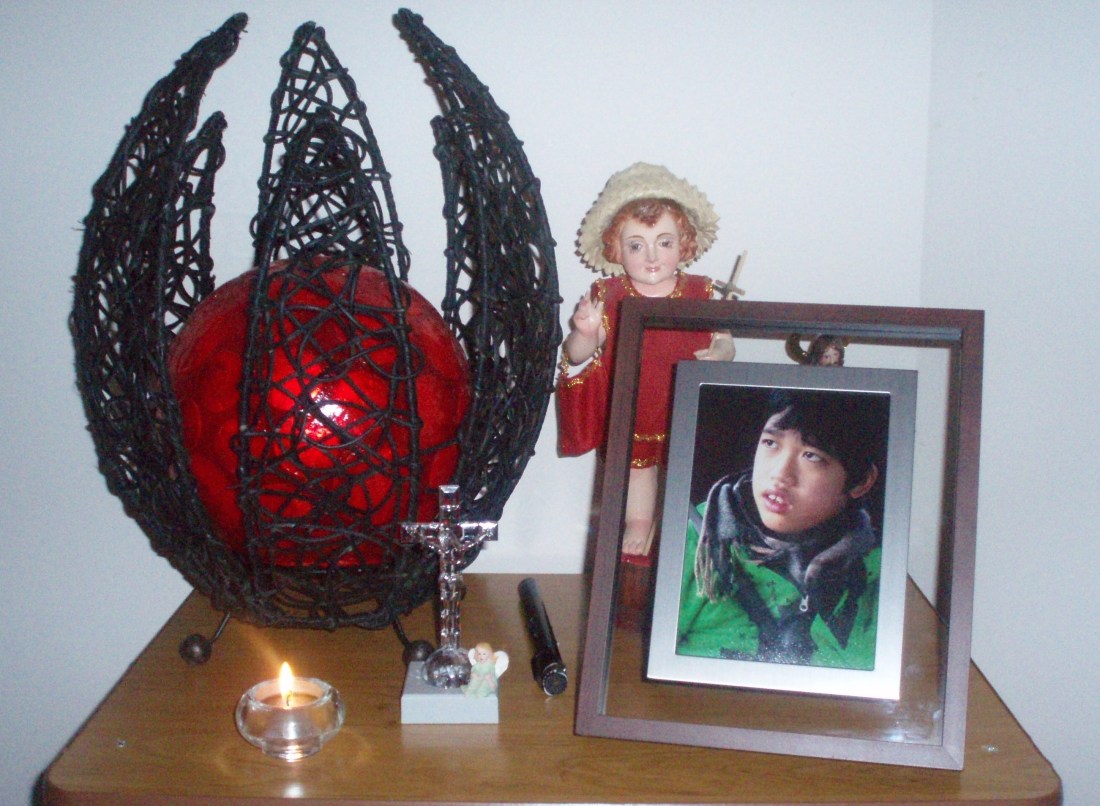 There is a sense of calmness and serenity as I enter Kevin’s bedroom. His toys are on the floor, scattered, yet well arranged. On the side of his bed leans a big cardboard collage of all his photos, like a mural painting depicting his life story. Lights are off; but flashes of red lights and casts of shadow come from a globe lamp gleam on the wall and the ceiling. Atop the dresser, there is a stoneware urn with two angel figures above the lid. Two photos of Kevin on a frame stand alongside. His face is bright, and his upper teeth protrude as he smiles. Small candles are lit and the scent of rose petals sprinkled on a glass plate fills the air as I move closer in to the dresser. Inside Kevin’s room is a shrine; and here, in that square tiny box, lie Kevin’s remains.
It was not long ago that Kevin used to stay most of the times in his bedroom, playing with his toy guitar or with squeaky balls or watching his favourite TV program. He would get really excited whenever he watched the Wiggles or the Thumb Wrestling Federation. He would sit right in front of the screen, his body bent forward. His hands were shaking, his eyes frozen on the screen. He was happy and at ease.
There were times when his younger sister, Kathleen, tried to annoy him by changing the channel to another TV program. “Kevin, I’m changing the channel,” she said. “Don’t change it… he’ll get angry at you,” Kevin’s dad, Clem, said. “Nah…he’ll be ok. He likes what I’m watching,” she said.
Kevin gave her a greasy look; his eyes widen, and he yelled “ah…. ah…” It would seem that he was not happy at all. Kathleen soon changed it back to the Wiggles, and Kevin looked back on the screen, swaying his body.
There were other times when his older sister, Kathy, came home from work. She walked past Kevin in his room and forgotten to say hello. Kevin would yell “ah…” and would always have a ‘puppy dog’ look, trying for his sister’s attention. Kathy went in to his room and gave him lots of hugs and kisses. She said “Ohhhh… sorry Kit Kit,” her name for Kevin.
Kevin loved attention. He would pick and choose who he liked and disliked. “If he does not like you, he won’t look at you. He’d yell, close his eyes or push you away. But if he likes you, he’ll try to grab your attention. He’d be lying down and want you to give him a hug,” Kathy explained, while she grinned.
Kevin’s brain did not fully develop as he was born six and a half months premature. Kevin Marzon Salem was born on the 6th of January 1992 and only weighed 1.4 kilograms. He was so small at birth that he would squarely fit in to Clem’s palm. He was cute, yet dark and hairy. He was in the intensive care unit (ICU) for three months and as the months went by, the family noticed that Kevin was different from other babies in terms of his growth and development. For instance, his lips would turn to blue—he had difficulty inhaling air into his lungs.
Eight months after his birth, Dr Dinah Reddihough, a Child Development Specialist at the Royal Children’s Hospital, diagnosed Kevin with cerebral palsy (CP). It was devastating news for the family. Clem often wondered why. But he had stayed strong for his wife, Cora.
“We were in shock to hear that Kevin had a cerebral palsy. We didn’t know what CP was. They explained to us that CP was a very complex disease and it has something to do with his brain that affects his movement,” Clem said.
The doctors noted that there was no medical history of CP in Clem and Cora’s family. “They only told us that he was a premature baby and that he may be one in a million kids who had this disease. This was all they told us. They did not tell us what would have caused Kevin’s premature birth,” he added, his eyes were red, his chest filled with sadness.
Further diagnosis of Kevin’s CP from other doctors pointed to the fact that his disease was caused by lack of oxygen during birth. It was also revealed that Cora’s fatigue and the fetus’ low position in her womb may have contributed to his early delivery. Kevin was also diagnosed with epilepsy and asthma, and he would have seizures from time to time especially when he was sick.
Clem and Cora were stressed, disappointed, and angry. As newly arrived migrants from the Philippines, they were confused and unsettled on Kevin’s medical condition. They decided they had to continue with their lives.
Kevin became part of their daily chores. They fed him, mostly with cereals; they bathed him and dressed him; they put him to bed at night and got him out of bed in the morning for school.
When Kevin was five years old, he started going to Uncle Bob’s Child Development Centre at Parkville. At Uncle Bob’s, Clem and Cora learnt from other families’ experiences. This gave Clem and Cora the insight on how to care for special kids like Kevin. Kevin learnt how to focus his attention with particular objects, mainly with toys, and learnt to interact socially with other kids with disabilities.
Kevin’s intellectual and physical development was slower than ordinary children. His bodily movement was severely affected. He would be on his wheelchair or sitting on the carpet most of the time. He also had speech difficulties. He would be saying “da, da, da, da…” or fake laughing “he… he” when he was excited or he would yell “ah…. ah” when he was angry. Furthermore, he had eating and drinking difficulties because certain muscles around his mouth and tongue areas were affected by his CP. He mainly ate cereals or foods that were easy to swallow such as rice with soup.
But Kevin had no difficulties with his hearing, touching and eyesight. He would complain when he heard Lady Gaga music and did not like girls either as they laugh a lot. He responded immediately whenever he heard his favorite music and TV shows. “He liked Thumb Wrestling Federation at Cartoon Network. Whenever he heard this show, although he was asleep, he’d get up quickly and watch it. His eyes would be fixed on the screen. He won’t move and he’d be a ‘snob’,” Cora said, there was lightness on her face.
Kevin’s sense of touch and perception were equally admirable. He liked dipping his body into the water, touching the grass, and stroking someone’s hair. At the shopping centre, he would stretch his arms and feel the fabric while his wheelchair glided across the clothing stand. When he was near the door, he would hold on to the doorknob and bang his head softly on the edge of the doorway. But most of all, he loved seeing his dad and he would get really excited; his hands would wave, his mouth wide open, his body swaying back and forth.
Three years ago, Kevin’s mental and physical development had improved enormously. He matured and gained weight from a little boy of nineteen kilograms to a young man at forty one and a half kilograms. He responded quickly when someone called his name. He made a lot of eye contact and communicated well by exerting verbal sounds. “Kevin can maintain his balance and upright sitting whilst sitting on a half moon bolster for greater than 3 minutes with close supervision… When highly motivated, Kevin will reach across his midline to explore objects,” wrote his teacher, Chris Hurst, in Kevin’s 2009 end of year school report at Glenroy Special School.
But, in late November 2009, Kevin’s day-to-day behaviour started to change. Most of the times, he would just be on the mattress, slumped. He did not move at all. Clem and Cora thought it was only his epilepsy, and that perhaps, it was because he was growing up and gained more weight in recent years. Kevin started to get numerous fits and would randomly vomit. His snoring was heavy at night and was very timid during day time.
On the 3rd of December, Clem and Cora drove Kevin to the Royal Children’s Hospital where he stayed for twenty four hours before he was transferred to the Northern Hospital in Epping. He was diagnosed with pneumonia, a recurring disease that he had had since he was five years old. Kevin’s pneumonia kept coming back whenever he had major operations. He had two operations, where he had pneumonia: one, putting a brace on his hips when he was eight years old; and second, removing the brace from his hips when he was nine. He struggled and managed to survive. But, Kevin’s recent pneumonia was worse than the two previous occasions, as his immune system could not fight off a deadly virus strain known as pseudomonas—a bacteria that attacks those who are already sick or who have weakened immune system.
Kevin was in the ICU in Northern Hospital for three days and was showing some improvements. He would open his eyes and watch the Wiggles, and his breathing was less heavy than before. He was transported back to the Royal Children’s Hospital’s ward for recovery. Shortly afterwards, Kevin was moved back to the Children’s Hospital’s ICU because of increased secretions in his lungs. The doctors put Kevin on a Bipap—a breathing-aid machine that would help improve his breathing.
Kevin and the rest of the family were at the ICU for five weeks, still hopeful of his recovery. But they were exhausted. Kevin was such a fighter. In the first two weeks, his lungs would continually collapse, but he would resist and manage to recover every time. Anger and frustration endured, as the family was still undecided on Kevin’s worsening condition. “They [doctors] said that Kevin was not doing well, and they wanted to make him as comfortable as possible; and that only meant one thing—that he was not going to make it,” Kathy said, her hands moved sideways as she explained.
On 6th day of January 2010, Kevin celebrated his 18th birthday at the ICU. His family and relatives gathered around him, each wore a birthday hat, and sang a birthday song for him. Around Kevin’s bed were bunches of flowers, balloons, stuffed toys and birthday cards. His body was reclined sideways on a bed, his eyes closed, panting heavily. He had an intubation inserted in his lungs as the Bipap no longer aided his breathing. Still, there was no sign of Kevin’s improvement. He was in so much pain that tears slid off Kevin’s eyes and disappeared into the weave of his white quilt.
After some reflections and long discussions with relatives and the medical staff, the family decided to let Kevin go. He died at 3.20 in the afternoon on the 8th of January 2010; his family, Clem, Cora, Kathy and Kathleen, were with him on his bedside.
“Our family is what it is because of Kuya. I could not imagine how it would be like if it wasn’t for him. I have learnt so many things about him,” Kathleen said, calling him ‘Kuya’, her big brother, in Tagalog language.
Cora comes from work. She goes straight to Kevin’s room, lies down on his mattress and cuddles his stuffed toys. Clem switches-on the TV and watches the Wiggles. In the study room, Kathy and Kathleen laugh, reminiscing about Kevin. “Ha…ha, yes, he is so cheeky and fat,” they tease.
Kevin is now at home; there in his little shrine, in his family’s hearts and memories.
 Reyvi Marinas